
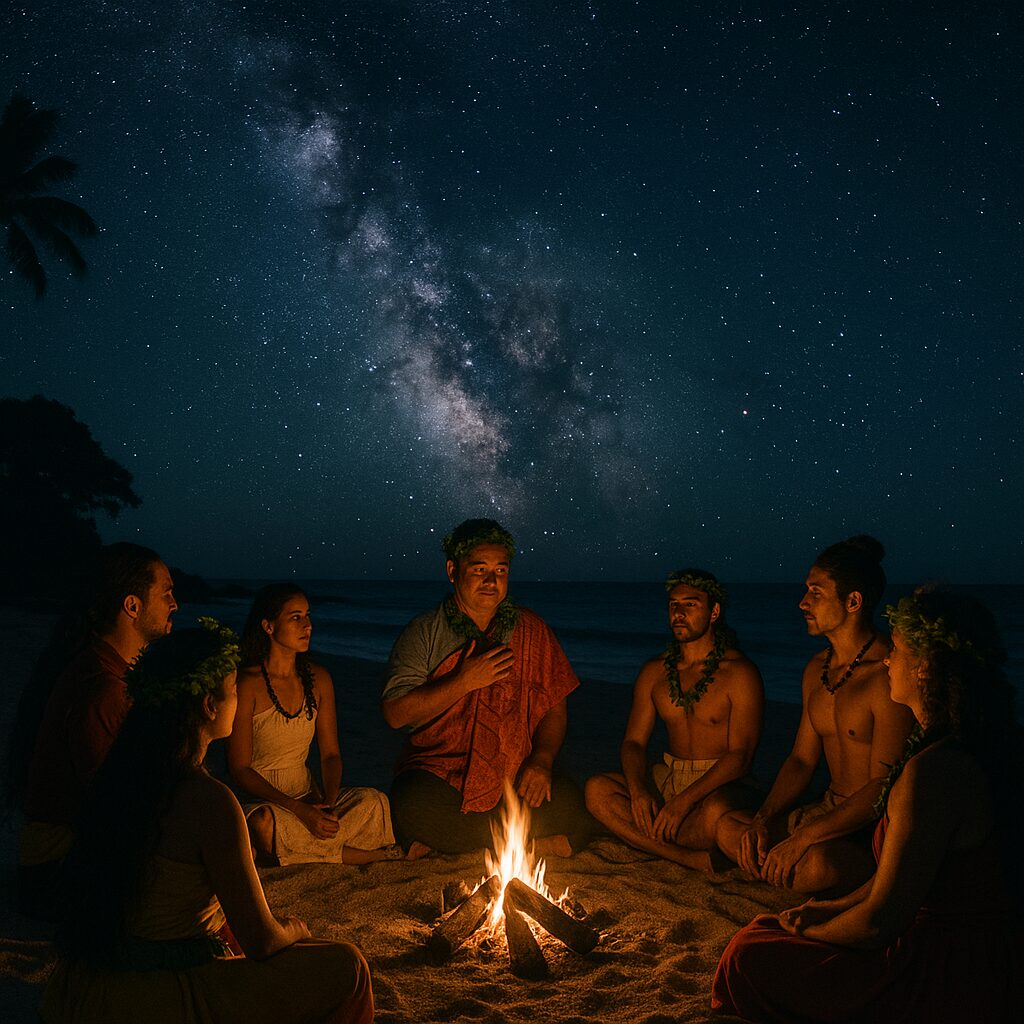
How an ancient Hawaiian ritual and a modern nervous system met in the same crack of light
⸻
Most people have never heard of Ho‘oponopono, the traditional Hawaiian ceremony for restoring harmony. Long before it was condensed into the feel-good phrase “I’m sorry. Please forgive me. Thank you. I love you,” it was a collective act of story repair.
The word itself means “to make right,” or “to correct what has gone out of balance.” When a Hawaiian family or tribe found themselves torn apart—by betrayal, illness, or disagreement—they didn’t call a lawyer or post about it online. They called a meeting.
Elders gathered everyone together in a circle, often with prayer, chanting, or symbolic offerings. It wasn’t a performance—it was an emotional reckoning. Everyone spoke the unspeakable: anger, shame, sorrow, resentment. The goal wasn’t to win. It was to empty the charge, to let truth clean the wound.
Through confession, forgiveness, and gratitude, the group would eventually reach pono—a word that carries layers of meaning: balance, right relationship, harmony between people, land, ancestors, and spirit. Once that point was reached, the old narrative was gone. A new one had to be written—one without villains or victims.
That’s what fascinated me when I learned about it later:
they were practicing collective narrative alchemy.
⸻
When My Body Became the Battlefield
I didn’t know any of this when my own version of Ho‘oponopono began—alone, in terror, with no circle of elders and no drumbeat of community.
The pain attacks came like lightning strikes. I could be sitting quietly, watching TV or making coffee, when a surge of agony shot down from my left shoulder, through my torso, and out the sole of my right foot. It was violent and sudden—like being plugged into a socket I hadn’t asked for.
Each strike left me shaking. The pain was physical, yes, but it carried intention. It felt aimed. Targeted. And when it hit, it brought a swarm of emotion: guilt for my family, shame for past failures, despair so thick it whispered, You’d be better off gone.
I was convinced something demonic was trying to push me toward suicide. I’d been spiritually open for decades—mediumship, journeying, downloads—and now it all turned against me. I couldn’t tell if I was losing my mind or waking up inside someone else’s nightmare.
Days blurred into weeks of terror. I hardly slept. Every quiet moment carried the threat of another strike. I’d lie there bargaining with my own nervous system, whispering please stop, feeling completely powerless.
⸻
The Experiment That Changed Everything
Then came the strangest discovery of my life.
One night, as I braced for another round, I noticed the physical sensations of terror—the fluttering stomach, pounding chest, surge of adrenaline—felt eerily similar to something else: excitement.
It hit me like a sideways insight. The same bodily chemistry that fuels panic also fuels anticipation. My brain was just labeling it differently.
So I started to experiment. When the next surge came, I told myself I wasn’t terrified—I was on a roller coaster. Not being attacked, but launched. The story changed, and so did the body’s reaction. The wave still hurt, but the meaning of it shifted.
And then came the moment that rewired everything.
A bolt of pain hit, harder than usual. Instinctively, without thinking, I said out loud:
“Thank you.”
The intense emotional reaction evaporated.
The pain didn’t disappear, but it lost its weapon.
It was as if my body was yelling at me and I’d finally turned to face it. The signal no longer needed to scream. My system froze in shock—like someone who’s been shouting for hours suddenly realizing they can stop.
From that moment forward, I said it every time: thank you.
And every time, the same thing happened. The intensity dropped. The panic subsided. My body responded like a child finally being listened to.
At first I thought I was crazy. Who thanks pain? But the results were undeniable.
⸻
The Hawaiian Connection
Months later, I came across a short article about Ho‘oponopono. When I read the four-line mantra, I nearly fell out of my chair.
I’m sorry. Please forgive me. Thank you. I love you.
There it was—the same pattern I had stumbled into on my own, except in ancient ceremonial form. I didn’t learn it; it found me.
That realization broke something open. I realized that, in my isolation, I had been led to rediscover a universal mechanism—the human reset switch. What the Hawaiians had once done for entire villages, my body had demanded I do for myself.
⸻
Talking to the Messenger
Here’s the secret most people miss:
you’re not thanking the pain, or the person who caused it.
You’re thanking the body—the loyal messenger that never stops delivering data.
The body isn’t a villain. It’s the processor running the emotional code that renders our stories. Every shock, every betrayal, every grief becomes stored data until awareness retrieves it.
So when the body flares in pain, it’s not punishing you. It’s trying to tell you:
“There’s a fragment in here you haven’t seen yet.”
That’s when I began to talk back.
Thank you for reminding me that this pain was still stored inside.
I’m sorry for ignoring your signals for so long.
Thank you again for carrying it until I was ready to see it.
Now I release the story. You can rest.
Each repetition strengthened the connection. My body became an ally instead of an adversary.
⸻
How and Why It Works
It’s not mysticism—it’s mechanics. The ritual works because it mirrors how the nervous system actually functions.
• Recognition breaks the loop. When we name what’s happening, the brain’s threat system calms down; awareness reenters the room.
• Gratitude flips the polarity. “Thank you” turns resistance into communication.
• Apology restores trust. The body relaxes because it knows it’s finally being heard.
• Surrender integrates the message. The story collapses back into neutrality, leaving only presence.
From a neurological perspective, this process rewires the amygdala’s fear loop. The instant you stop resisting, the body no longer interprets the sensation as danger. Adrenaline drops, muscles unclench, and the system begins to self-regulate.
From a metaphysical perspective, it’s exactly what the Hawaiian kahunas were doing—resetting the emotional field.
Where they healed tribes, I was healing a nervous system.
Different scale, same principle:
rewrite the story so life can continue.
⸻
A Broader Mirror
Sometimes I imagine those ancient circles on the beach—firelight flickering, waves hissing, old voices rising and falling in rhythm. The ceremony wasn’t only about individuals; it was social engineering in the most sacred sense.
When a tribe practiced Ho‘oponopono, they were ensuring survival. A community infected with resentment can’t hunt, can’t farm, can’t raise children in safety. The ritual wasn’t sentimental—it was practical. The group had to deconstruct the emotional architecture of conflict and agree on a new story that everyone could inhabit.
That’s exactly what happens internally when we practice gratitude toward pain. The tribe within—all our fragmented parts—has to come into alignment. The fearful part, the wounded part, the angry part, and the witnessing part all sit around the same fire. And through recognition, apology, gratitude, and love, they find pono again.
I’ve watched this same principle play out with clients and friends. Someone will have chronic neck pain, or looping anxiety, or grief that never quite leaves. The moment they shift from “make it stop” to “thank you for showing me where it hurts,” the body softens. Tears come. A floodgate opens. The story that held the pain together collapses.
That’s not placebo—it’s communication finally restored.
⸻
Beyond Pain
This practice isn’t about positivity or spiritual bypassing. It’s about right relationship with the messenger.
Pain—whether physical, emotional, or ancestral—shows up when a story has outlived its usefulness. When we thank the messenger, the transmission completes. The body stops shouting. The nervous system resets.
The system updates.
The story dissolves.
What remains is presence—the Crack, clear and alive.
Binding
Thank you for carrying what I could not feel.
I’m sorry I turned pain into an enemy.
Please forgive my resistance.
I love you for showing me how you feel.
You no longer need to carry this. The story ends now.
I return to balance — pono —
clear, present, and free.
Discover more from Shattering the Matrix
Subscribe to get the latest posts sent to your email.
It is a beautiful ritual, but remember the body knows what trauma it has endured. Some people will never fully heal their body, but they can heal their soul. The trauma will always be there but it is no longer in control. I really believe that there are some acts that are unforgivable. If you can’t’ bring yourself to forgive someone, that is okay. People say you won’t have peace if you don’t forgive, that is not true. So if you have a situation that you cannot forgive, be kind to yourself. You can still have peace without forgiveness, especially when you’re viewing life from the crack.