

(Without Stopping Loving Men)
Let’s get the obvious out of the way first:
I didn’t stop being gay. My orientation didn’t change, my desire didn’t shift, and I didn’t wake up one morning craving a minivan and a woman named Carol.
What changed was the story wrapped around my sexuality — the inherited identity, the programming, the expectations, the emotional choreography I was taught to perform.
This isn’t an article about changing who you’re attracted to.
It’s about waking up from inherited story-scripts and realizing how much of your “self” wasn’t actually you.
Sexuality is innate.
Identity is engineered.
And the identity I’d been running — the one society calls “gay” — wasn’t written by me.
It was installed.
Like an iPhone update I never agreed to.
⸻
You’d be surprised how much of your life isn’t actually yours.
Not your thoughts, not your anxieties, not your insecurities, not even your sense of humor.
Whole parts of your personality come preloaded like an iPhone update — courtesy of history, trauma, religion, TV, and whatever emotional storm the collective is running this decade.
Most people never figure that out.
They die thinking their “self” was hand-crafted, artisanal, organic, locally sourced.
Meanwhile half their personality was grown in a factory overseas and shipped through childhood, culture, and a thousand invisible narratives vying for their attention.
I was one of those people.
⸻
The Stuff You Think Is “You” (But Actually Isn’t)
We like to pretend our personalities are handcrafted, small-batch “selves.”
The truth? They’re mostly preloaded software:
• family trauma
• religion
• pop culture
• the 90s
• survival strategies
• whatever stories your parents were trapped in
• whatever the herd needed you to be so it could stay comfortable
I didn’t know that at the time.
I just thought I was… well, me.
But when I finally collapsed out of my life — pain, betrayal, Arizona, the whole phoenix-in-a-trash-fire era — I started to see the architecture.
I thought I was discovering deep personal truth.
What I was actually discovering was how identities get written into us before we ever make a choice.
And “gay identity” was simply one of the masks I caught myself wearing.
⸻
Identity Isn’t a Label
It’s a Handshake Protocol
I was never “gay” in the cultural sense.
Gay wasn’t a preference — attraction isn’t a preference — it’s innate, biological, baked in from the start.
But the lifestyle, the persona, the behavioral package that gets wrapped around that attraction?
I definitely didn’t install that myself.
Here’s what took me decades to understand:
Identity isn’t a label.
It’s a handshake protocol.
The moment you say “I’m this,” whether it’s gay, straight, nonbinary, witch, christian, accountant, or football player — the field registers your signal.
Once that identity-handshake is complete, everyone who shares that label can suddenly read you, and you start sharing information with them.
Literally. Energetically.
It’s the same instinct that lets birds swarm, ants coordinate, or soldiers fall into formation without talking.
Humans do it too — we just pretend we’re too sophisticated to admit it.
When you hang out with others who share your identity, there’s a data exchange.
Sometimes tiny.
Sometimes massive.
Always unconscious.
A little behavioral sync here.
A micro-expression there.
Some shared survival coding.
A whole archive of reactions you didn’t consciously choose.
It’s a handshake that asks:
• Are you safe?
• Do you follow the same story?
• Do we run the same emotional software?
• Can I relax around you?
• Will you understand me without me having to explain myself?
That’s the identity field doing what it does best: synching your software.
⸻
The Subtle Identities We Don’t Know We’re Performing
The loud identities are easy to spot — gay, straight, political party, religion, job title.
But the real possession happens in the soft ones.
The quiet identities.
The ones that feel like “just me,” even though they were scripted long before you had a say.
Here are some of the identities people never realize are identities:
• The Wounded Child
The entire psyche rearranged around an injury that happened decades ago, still running the same emotional software because the field hasn’t been cleared.
• The Caretaker
Not kindness — compulsion. A person who learned early on that love was earned through service, so they never stop serving.
• The Fixer
Runs into every burning building with a smile, convinced their worth is measured by the crises they solve.
• The Peacemaker
Lives life as emotional Teflon — absorbs everyone else’s mess so no one gets upset. That’s not peace. That’s possession.
• The Performer
Trained to be charming, funny, dazzling — a distraction so no one sees the fear underneath.
• The Perfectionist
Someone who believes safety is earned by getting everything right. Trauma wearing a suit.
• The Invisible One
Blends in, shrinks down, makes themselves harmless to avoid punishment.
• The Reliable One
The person everyone depends on — except it was never a choice. It was a childhood role that calcified.
• The Liar
Not malicious — protective. A person who learned early that truth created danger.
• The Narcissist
A collapsed self, building a hologram of identity because the original self was never allowed to exist.
• The Psychopath
Not the Hollywood version — the emotionally-severed version. A person who survived by switching off empathy so they couldn’t be controlled by it.
• The Hero
Trapped in a savior script where helping feels like purpose but is actually compulsion.
• The Rebel
Defined entirely by opposition. Without something to push against, they disappear.
• The Good One
A lifetime of being quiet, obedient, non-threatening — emotional taxidermy passed off as virtue.

⸻
Why We All Play Roles We Didn’t Choose
Here’s the big reveal:
Every one of these identities is a wavelength.
A frequency.
A story-shape the herd runs to keep the organism functioning.
Humans act out identities the same way:
• bees act out hive roles
• ants act out colony roles
• birds move in murmuration
We call it “personality.”
But it’s story possession running on emotional fuel.
Emotion makes the story believable.
Story makes the identity believable.
Identity makes the loop believable.
You don’t question what you’re feeling
so you don’t question what you’re doing
so you don’t question the role you’re performing
so you don’t question the story running your life.
That’s how the squid keeps the show going.
⸻
This Is Why Every Group Has a Vibe
Because identity is contagious.
Every group radiates a specific emotional wavelength, and if you walk into it unaware, you get drafted into the field without consent.
• Team sports: loyalty, aggression, belonging
• Cub Scouts: order, obedience, bright-scrubbed virtue
• Fraternities: dominance, hierarchy, ritualized masculinity
• Corporate offices: performance, ambition, strategic smiling
• Nursing staff: hyper-responsibility, suppressed trauma, battlefield humor
• Yoga studios: spiritualized perfectionism wrapped in stretchy pants
• Spiritual retreats: bliss-chasing, guru projection, competing awakenings
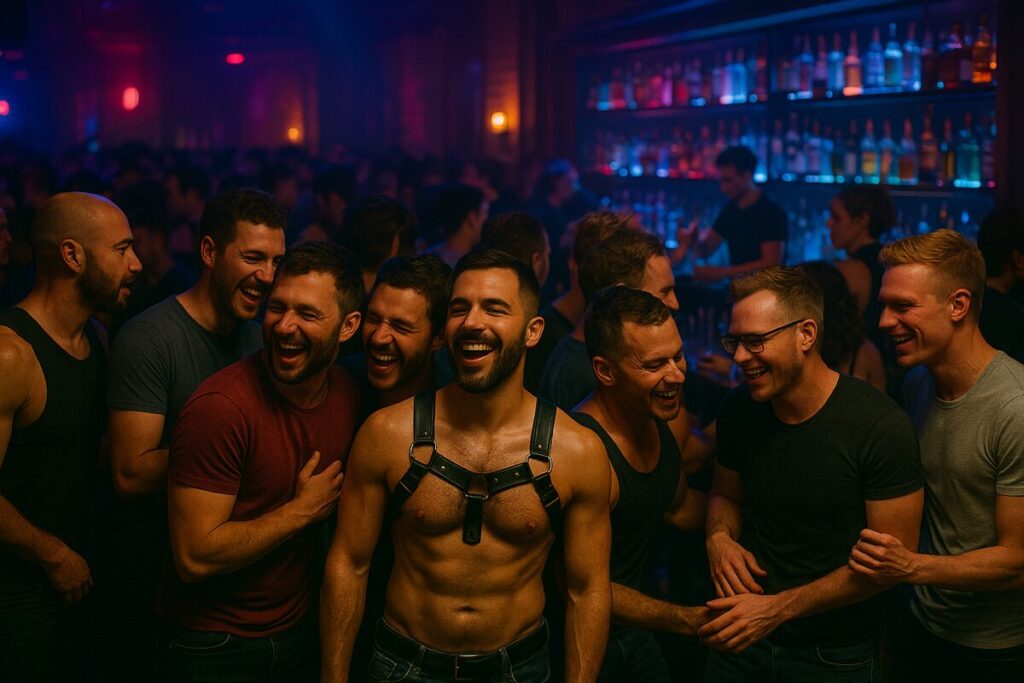
• Gay bars: coded performance, shared wounds, humor-as-armor
• Kink clubs: shadow exploration, catharsis, boundary theater
• HOA meetings: a horror genre all its own — power-tripping elders possessed by the spirit of Robert’s Rules
These aren’t just communities.
They’re identity fields.
Step into one, and it tries to tell you who you should be.
Most people don’t even notice when their tone, behavior, humor, posture, or energy shifts to match the room.
The vibe isn’t an accident.
It’s a signal.
And the signal pulls you into the story.
Every group comes pre-loaded with an energetic script shaped by everyone who’s ever walked in before you.
An airdrop of expectations, behavior patterns, emotional tone, and unwritten laws.
When you’re the outsider, it feels scary — not because the people are dangerous, but because your body recognizes you’re not tuned to their frequency yet.
Your system scans theirs.
Theirs scans yours.
All without a word exchanged.
⸻
Being Gay Isn’t Optional
The Lifestyle Is
So when I say I was never “gay” in the cultural sense, what I really mean is:
I never ran the full lifestyle package —
but I still downloaded fragments of it because that’s how energetic beings sync for safety and belonging.
The attraction — that was mine.
That was real.
That was non-negotiable, biological, native code.
But the persona that comes bundled with the “gay” identity was something else entirely.
I met every kind of gay man over the years — and since we aren’t physical beings having energetic experiences but energetic beings wearing physical costumes, the exchange happens long before words do.
Being around enough gay men meant I was constantly exchanging data with them via the “gay cable connection.”
Not consciously.
Not intentionally.
Just by proximity.
A gesture here.
A tone there.
A survival tactic wrapped in humor.
A flamboyant flourish that wasn’t “me” but somehow booted up on command like a pre-installed app.
It wasn’t mimicry.
It was resonance.
Proximity-based calibration.
Identity feels like belonging because the field syncs your software to the group template.
It feels reassuring… until it doesn’t.
Until you realize some of those programs you’ve been running aren’t yours.
⸻
Everyone drags their childhood into bed.
Everyone has attachment wounds and inherited patterns.
Everyone has many stories running them.
Attraction isn’t the problem.
Love isn’t the problem.
Sex isn’t the problem.
The problem is the historical software we’re all forced to download with any identity we assume.
There was a time — a long time — when same-sex attraction wasn’t shocking at all.
Ancient cultures didn’t even have words for it.
People loved who they loved.
The shame wasn’t born in us. It was engineered — a religious control mechanism designed to weaponize fear and keep people obedient.
That weaponized shame still echoes inside the gay archetype today, baked into the identity field like hand-painted detail on porcelain.
So modern “gay identity” isn’t just about attraction.
It’s layered with centuries of trauma, rebellion, survival performance, stereotype, politics, comedy-as-shield — and of course, all the products you can buy to express your “individual identity.” The market always finds its consumers.
If you don’t know that’s what you stepped into, you think it’s all “just you.”

⸻
When the Identity Fell Apart
Then my life collapsed.
The pain, the marriage ending, the exile to the desert — every identity I had ever worn fell off.
Not poetically. Literally.
The emotional energy that animated them was gone.
I couldn’t be anything:
Not “gay.”
Not “healer.”
Not “hairdresser.”
Not “good son.”
Not even “funny Greg.”
Every role evaporated in the demolition.
And in the empty space that followed, I saw something I had never seen before:
My sexuality remained — clean, simple, unburdened —
but the gay lifestyle was gone.
The flamboyance-on-command? Gone. Seen for what it was: a defense mechanism.
The trauma-echo? Gone. I didn’t need any more guilt than I already had from the other identities I was wearing.
The stereotype residue? Gone. No longer needed.
The rebellion? Gone.
The shame? Gone.
The whole current. Gone.
I wasn’t straight.
I wasn’t closeted.
I wasn’t confused.
I was just… me.
A man who loves men.
Without the identity-field running my personality.
Without the archive dictating behavior.
Without the cultural script performing itself through me.
A truth.
A reality.
A lived fact.
Not a template.
Not a community costume.
Not a trauma package.
Not a persona written by culture.
Just mine.

⸻
It Wasn’t My Sexuality That Changed
It Was My Sovereignty
Leaving “gay identity” wasn’t about straightening out.
(Please. I can’t even straighten a picture frame.)
It was about walking out of a story I didn’t write.
When you step into the Crack — that quiet, neutral place outside the loop — you can feel the difference immediately:
• What’s actually you
• What’s inherited
• What’s compensatory
• What’s trauma dressing as personality
• What’s performance
• What’s story possession
And once you see it, you can’t unsee it.
I didn’t abandon anything.
I reclaimed everything.
I kept the orientation.
I let the identity die.
I kept the love.
I let the programming go.
I kept the truth.
I dropped the script.
⸻
The Real Revelation:
Your Sexuality Never Needed Fixing
The straight world tries to fix you.
The gay world tries to claim you.
Religion tries to shame you.
Politics tries to tokenize you.
The New Age tries to spiritually sanitize you.
Everyone wants a piece of the gay man — for representation, for rebellion, for marketing, for narrative fuel.
But underneath all of that noise is something simple:
You are not your story.
You are not your identity.
You are not the character the world needs you to play.
You’re awareness.
You’re presence.
You’re the watcher in the Crack.
And sexuality — real sexuality — doesn’t live in the story.
It lives in the body, in the field, in the instinct, in the truth.
Identity is the costume.
Orientation is the signal.
The costume can go.
The signal remains.
⸻
So No — I Didn’t Stop Being Gay
I stopped being a story called Greg that “gay” guy.
I stopped being:
• the trauma-coded version
• the performance-coded version
• the rebellion-coded version
• the survival-coded version
• the herd-approved version
I stopped being possessed by an identity I didn’t write.
What’s left is clearer, calmer, truer — and a hell of a lot more me.
Still loving men.
Still queer.
Still me.
Just not owned by the story anymore.
Discover more from Shattering the Matrix
Subscribe to get the latest posts sent to your email.