
(How the Solstice Became a Corporate Trap and Why I Never Fit Inside It)
The older I get, the more obvious it becomes: most of our holiday trauma wasn’t created by childhood, or family, or religion, or even the season itself.
It was engineered.
Sold to us.
Installed like software.
And the people like me — the ones I jokingly call The Broken Ones — we were never meant to fit inside it. We’re the outliers. The ones who grew up at the jagged edges of the machinery and saw the gears moving long before we had language for what we were looking at.
Before it was Christmas, it was just the solstice.
December 21st.
The longest night of the year.
A pause.
A turning.
A moment to sit with the dark and wait for light to return.
There was no pressure.
No performance.
No debt.
No forced cheer.
Just a cosmic exhale.
Then Christianity came along and did what it does best: it inverted everything.
Stillness became obligation.
Darkness became shame.
Waiting became guilt.
Reflection became ritual.
Nature became an enemy — something to dominate rather than a rhythm to listen to.
But the real damage didn’t happen until capitalism saw an opportunity.
That’s when the inversion hit industrial scale.
The solstice was rewritten as the most profitable narrative in human history.
A corporate ceremony.
A consumption ritual.
A psychological trap dressed up in red and green and wrapped in glitter.
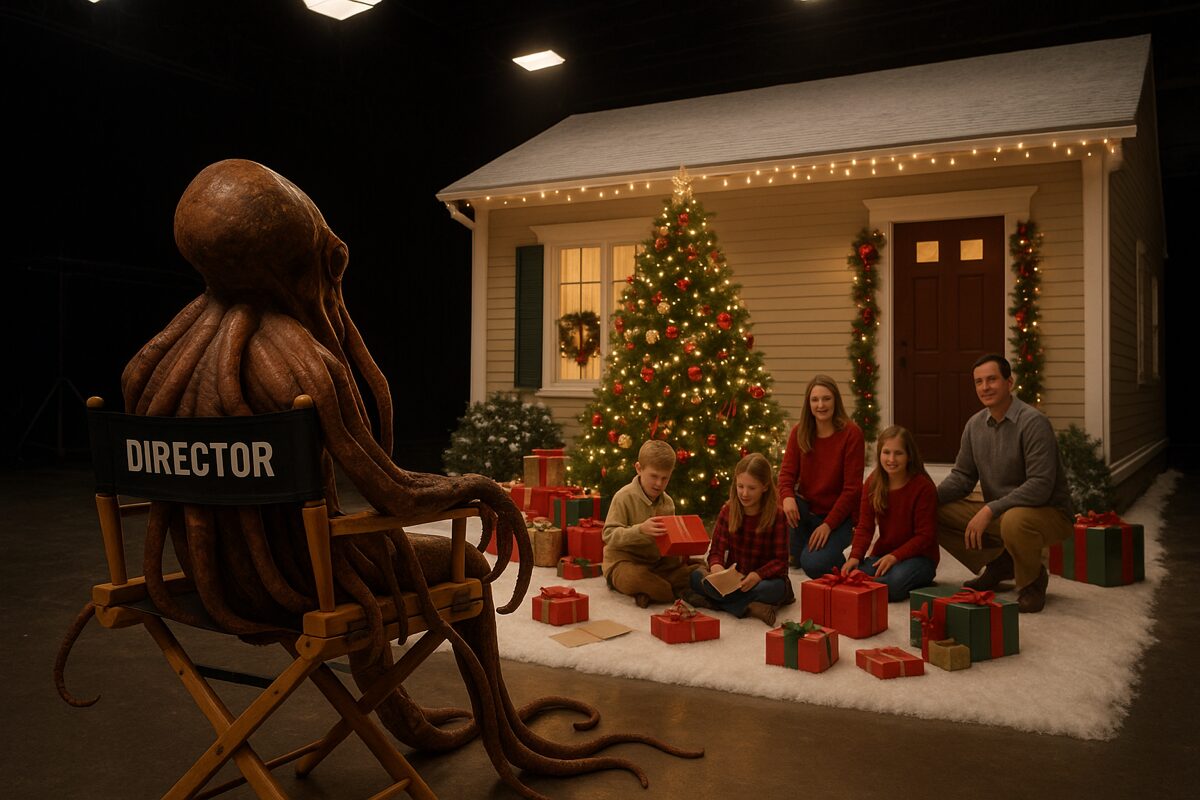
The modern holiday season isn’t tradition — it’s fiction.
Carefully crafted.
Perfectly staged.
And sold back to us as nostalgia.
The perfect family, in the perfect home, with the perfect lighting, and the perfect tree.
The children behave, the house sparkles, the parents don’t argue, and nobody has indigestion. Even the dog looks groomed.
Then you look at your own life and wonder why everything feels like a crime scene.
Last year’s “perfect gifts” are sitting in the trash, making room for this year’s upgrades.
And you start to believe that you’re the one failing — not the story.
Trauma isn’t born from failure.
Trauma is born from believing you were supposed to succeed in a script none of us wrote.
And because the pressure is impossible, people break.
Or they hide.
Or they drink.
Or they fight.
Or they dissociate their way through the season like they’re waiting for parole.
Meanwhile, the system sells you a drink for the stress, a pill for the anxiety, a therapist for the breakdown, a vacation for the burnout, and a product for the shame.
It manufactures the wound and then sells you the cure.

I know because I lived inside the performance.
I grew up in a house next door to the biggest Baptist church in town.
My family also ran a business that serviced everyone in that town, so according to social standards and a mom that spun them through her emotional wounds, our Christmas tree had to be absolutely perfect. Capital P. Exclamation point.
Perfect wasn’t decoration — it was reputation.
Every churchgoer walking past our window had to see that we were respectable, successful, spiritually aligned — a shining example of whatever America was performing that decade.
By December, she was always exhausted, so my siblings and I would be forced to decorate the tree. And we knew exactly what was coming.
We wrapped bulbs around each branch, not just on the outside, the entire thing — and not just the side facing the road — we tried desperately to anticipate her impossible standards.
Then she’d burst in, slam the business to a halt sure to remind us know that it was because of us she had to shut it down, then rip everything we had spend hours doing off the tree, and redecorate it from scratch while barking orders like a deranged general rearranging troops. She called this “teaching” us how to do it the “right way.”
By the end, we weren’t children anymore.
We were zombie soldiers.
“Put that gingerbread man there.”
“Yes, Mom.”
“Not there — THERE.”
“Sorry. Yes, Mom.”
For years, I thought something was wrong with me because I couldn’t slip into the holiday trance the way everyone else seemed to.
Now I see it:
Nothing about our holidays was actually real.
Nothing was normal.
Nothing was ours.
We weren’t celebrating anything.
We were reenacting a corporate manufactured hallucination tied to a religious belief.
And underneath that performance sits a truth almost no one wants to admit:
Nobody escapes the holiday Squid because they’re “healthy” or “strong” or “evolved.”
The Squid isn’t looking for the broken ones — it’s looking for the pressurized ones.
Possession is determined by how much pain you’re ignoring.
Every holiday table has a well of unspoken emotion sitting under it.
Resentment.
Grief.
Dread.
Shame.
Disappointment.
Exhaustion.
Unspoken rage.
Ignore it long enough, and the Squid doesn’t come for you — it comes from you.
It rises straight out of whatever you’ve shoved down all year.
It animates the energy you refuse to feel.
And suddenly someone is acting it out at Christmas dinner.
That’s when the system assigns the roles:
the one who snaps,
the one who cries,
the one who storms out,
the one who drinks too much,
the one who “ruins the holiday.”
It’s not destiny.
Not dysfunction.
It’s physics.
Emotional pressure meets narrative opportunity.
Most families call this “tradition.”
I call it possession by unresolved emotional debt.
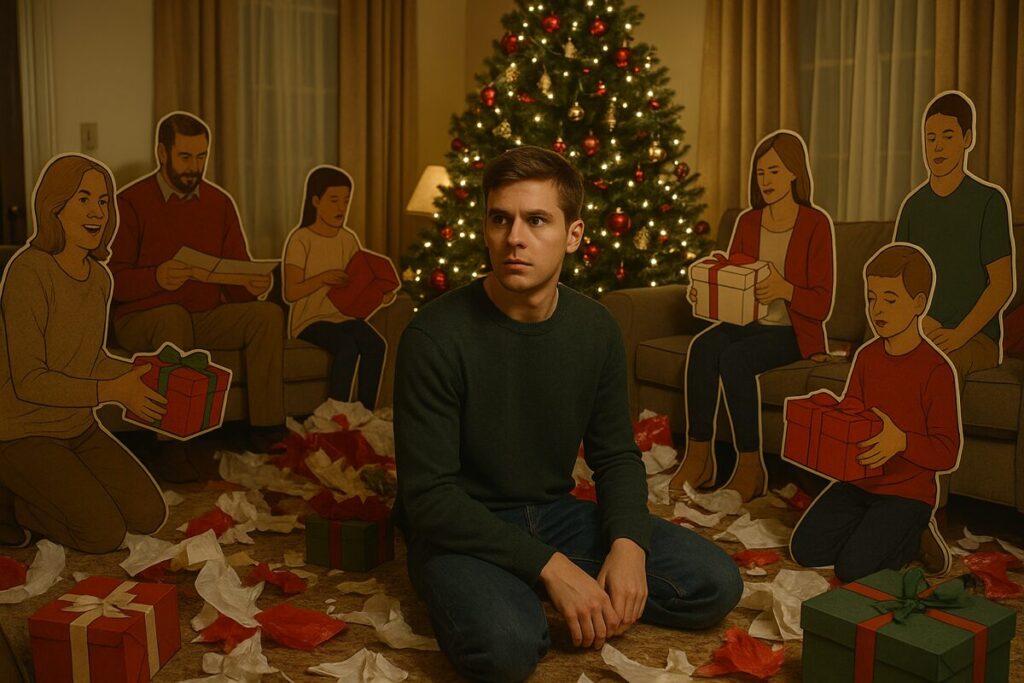
Which is why the best Thanksgiving I ever had wasn’t with family at all.
It was with a table full of adult orphans —
people whose families were too far away, too chaotic, or too broken to return to.
We cooked enough food to feed an army.
Every dish, every dessert, every culinary crime we could dream up.
And it was great.
Not because of the food.
Not because of the holiday.
But because there were no tentacles in the room.
No inherited pressure.
No ancestral scripts.
No Squid rising through decades of ignored pain.
Just people.
Just presence.
Just peace.
These days, I don’t mistake the feeling anymore.
I used to think my holiday anxiety was personal — a flaw in my wiring.
Now I understand:
none of it was mine.
It belonged to the collective story, the corporate machinery, the capitalist hallucination — the Squids animating all of us to keep the story believable.
I only felt it because I’m porous enough to register the signal.
I still sit with family during the holidays — that part hasn’t changed.
What’s changed is what I see happening inside myself when the irritation kicks in.
Someone throws a barb, or a half-truth, or a passive-aggressive Christmas cookie of a comment, and suddenly the whole internal courtroom lights up.
Before, I thought that reaction was me.
Now I know it’s the machine, asking for fuel.
Even the stories that feel justified — the grievances, the internal monologues that feel righteous — they all originate from the same well of pain. Not personal pain.
Just pain no one wanted to feel.
Once you see that, it becomes almost funny.
Because no matter how unique your story feels in the moment, it’s just the Squid running an old program.
It’s just another ancient loop surfacing to reenact itself using your face and your voice.
You stop seeing your family as enemies or obstacles.
You start seeing them as what they really are:
The Broken Ones.
Your tribe.
The Lost Boys of emotional Neverland —
shape-shifted by wounds they didn’t choose, performing roles they never auditioned for.
And the difference now is simple:
You can actually grow up.
Not in the Hallmark way —
in the Crack way.
Growing up — real growing up, the Crack kind — means dropping the need to believe your own narratives.
It means seeing your thoughts for what they actually are:
plot points designed to generate emotional charge, not divine truth.
It means recognizing that those righteous mental monologues lighting up in your head aren’t personal at all —
they’re architecture.
They belong to the Squid, the old role, the inherited family machinery trying to reboot itself through you.
And here’s the part nobody warns you about:
Once you see the architecture, you also see the exits.
You start to realize that certain people aren’t “difficult” —
their emotional field has gravitational pull.
They collapse your boundaries, hijack your nervous system, and rewrite your script the second you get within twelve feet of them.
You don’t just react to them —
you become who they need you to be so their holiday narrative feels complete.
That’s when growing up takes its final, scandalous form:
You stop going.
You create a new tradition —
one that doesn’t involve being devoured by someone else’s emotional ecosystem.
And yes, the first time you do it, your brain will scream:
“Oh my God, am I really spending the holiday without family?
What will they think?”
Here’s the secret:
they’ll think whatever their script tells them to think.
They always have.
That’s not your problem.
Growing up means you finally stop performing in the scenes that hurt you.
It means you stop sacrificing yourself to keep the family mythology intact.
It means you choose peace over performance, clarity over obligation, and actual presence over emotional possession.
It means you finally understand:
If the holiday requires you to disappear
in order for everyone else to feel okay,
it’s not a holiday —
it’s a hostage situation.
And that’s when you give yourself permission to step out of the story entirely
and build something new
from the Crack.
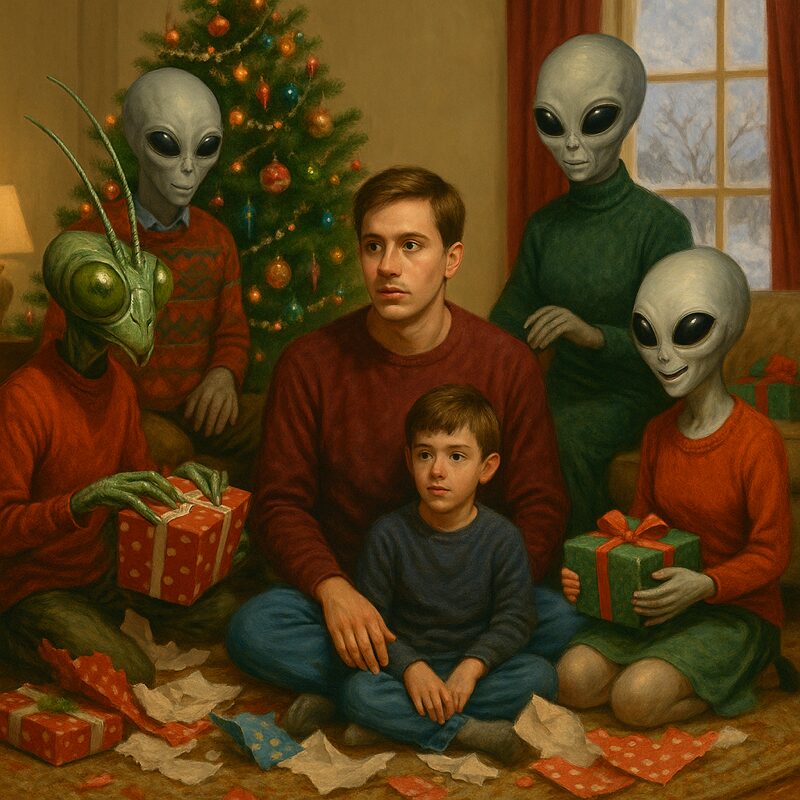
That’s when I do what I’ve learned to do.
I step into the Crack —
the only place where the story doesn’t render.
My protocol is simple:
This is not mine.
I see you.
Thank you.
Now go away.
Not mystical.
Not dramatic.
Just clarity — the kind that comes from standing outside the machine long enough to recognize its voice.
And then the moment passes.
I’m back.
Present.
Unhooked.
Still sitting at the same table…
but no longer inside the story.
I don’t ask myself how to “fix” the holidays anymore.
I ask:
Where did this pressure actually come from?
Because it wasn’t the solstice.
It wasn’t nature.
It wasn’t spirit.
It wasn’t love.
It was the marketplace.
And here’s what I finally see:
I didn’t “fall out” of anything.
The holiday machinery spit me out because I couldn’t make the story run.
The roles didn’t fit.
The script didn’t stick.
The programming slid off.
Once you see the gears behind the glitter, you can’t pretend the glitter is holy.
You can’t un-know that the quietest night of the year was turned into a commercial furnace, and we were expected to smile while standing inside it.
So now I watch the holidays from the Crack —
that thin place where the narrative can’t quite reach.
Not above it.
Not healed from it.
Just… outside of it.
I spent years thinking I was the broken one.
But the truth is simpler:
I wasn’t built to run the story.
And the story was never built for anyone who can see the machinery.
That’s not enlightenment.
It’s not liberation.
It’s just the reality of where I stand now—
on the edge of the holiday trance-field,
clear-eyed,
unsynced,
and finally able to recognize the difference
between a season
and a script.
Discover more from Shattering the Matrix
Subscribe to get the latest posts sent to your email.